Traveling with a baby imposes a different kind of schedule than we have followed in the past -- you leave the hotel at around 10am, come back for a mid-afternoon break, then turn in for the night at around 8pm (which is late by our new standards). That leaves lots of time, however, for Gus's favorite vacation activity: climbing around on Mom and Dad.
Once we managed to peel ourselves out of bed, we decided to climb another mountain and check out Guksadang, which our guidebook refers to as a "shamanist village" located on Inwangsan, a small mountain at the western end of Seoul.
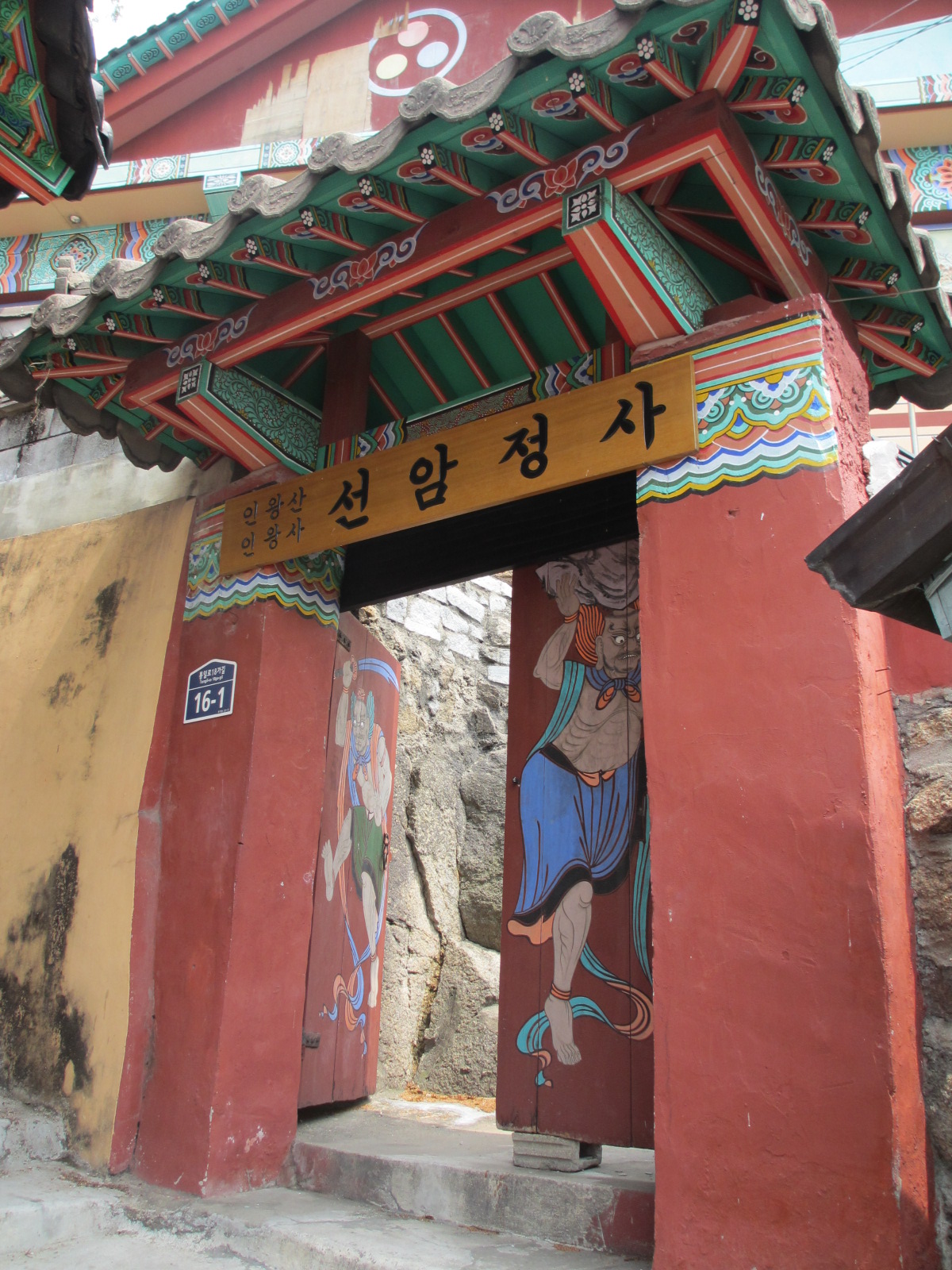
This is the entry gate to Guksadang -- we thought we'd done a fair amount of climbing at this point, but it was only the beginning.
Lots of cranes painted and carved on things.
Guksadang sort of messed with my (naive) mental categorization of East Asian religions -- there were paintings depicting scenes from the life of Buddha, and also a pig being prepared as an offering -- something I never would have thought to associate with Buddhism. When we came back to this same spot on the way down there were a couple of guys butchering the pig; we didn't photograph that because we thought we might be interfering with some serious ritual stuff.


This rock formation is called Seonamsa, and there's a couple of stories behind it. One of them is that the two rocks are shaped like Taejo, the founding king of the Joseon dynasty, and his friend and adviser, Master Monk Muhak. Another of the king's advisers, Jeong Dojeon, told him that if Seonamsa was included within the city wall, then Buddhism would flourish in the kingdom, and if it was outside then Confucianism would flourish. The king arranged the wall so that Seonamsa was just outside, to which Muhak responded, "from now on, monks will have to follow scholars around carrying their books."
Behind us you can get a sense of the (awesome) view from Ingwansan -- a line of highrise buildings in downtown Seoul. Right next to my ear is Namsan; the mountain with Seoul Tower on the top of it. We could see it, but it didn't really come out in the photos.
As we got a little further up the mountain, these rock paintings were everywhere. I have no idea what they said. We made a point of being quiet while hiking around because we would often round a corner and come across people (usually middle-aged women) sitting and practicing meditation.
Near the foot of the mountain is the
Seodaemun Prison History Hall, which is a museum/memorial set up on the site of a prison that was built during the Japanese occupation of Korea (1908-1945). After liberation, it served as a handy place to keep pro-democracy activists and was in active use until 1987.
If I hadn't known it was a former prison, I'd think the building looked sort of like a high school.
This was a memorial room where the walls were covered completely with pictures of Koreans who'd been imprisoned here for working with the resistance during the Japanese occupation. They attacked infrastructure, assassinated Japanese officials, targeted collaborators, and generally just made occupying Korea as unpleasant as they could. In return, lots of them were imprisoned, tortured, and killed.
Some of the rooms had been turned into life-sized dioramas with mannequins exhibiting the various torture techniques used to extract information from prisoners and illustrating the general horribleness of life in Seodaemun. We forgot to get pictures of those, so you'll just have to use your imagination. (Spoiler alert: K-pop is
not the only thing that was popular in Asia before Americans jumped on the bandwagon.)
Gus is handling prison life much better than Quinn is.
I'd always thought the
panopticon was just a disturbing metaphor for the modern surveillance state, but they actually built one in the prison's exercise yard. There's a platform for the watchman to stand on (I used it to take the picture) and the prisoners were in walled-in enclosures that spread out like a fan, allowing the watchman to see everyone without having to move at all.
After a morning of sacred mountains, pig butchering, violent insurgency and torture, our thoughts naturally turned to lunch. Quinn really wanted to visit Gangnam to see whether it's anything like the
video. It was raining, so it was sort of hard to tell. We did find a place near the Sinsa subway station where we got some awesome
galbi. It was a spicy beef stew that was kept warm by a little propane burner on the table. We opted for the version with octopus in it; there were others. It also had mushrooms, noodles, and other vegetables in it. When it became clear that we were
galbi rookies, the waiter came by and used the (ubiquitous) tongs and scissors to remove the beef from the bone and get the vegetables and octopus into more manageable pieces. They offered spiciness levels from 1 to 5; we opted for a 2 and found it to be toward the upper end of the pleasant range. Anything more than a 3 probably would have been inedible.
After lunch we proceeded to the National Museum of Korea. This was probably Gus's least favorite stop, and I can think of two possible explanations. Either we've raised a boy who already dislikes Joseon-era pottery or (more probably) it was the quietest place he's ever been in his entire life and he found it really distressing. The grounds around the museum were also really impressive; Quinn liked these flowers.
After the museum we went back to Myeongdong and the Namdaemun market, which was noisy enough that Gus fell right to sleep. This is the Namdaemun gate, now located in a traffic circle.
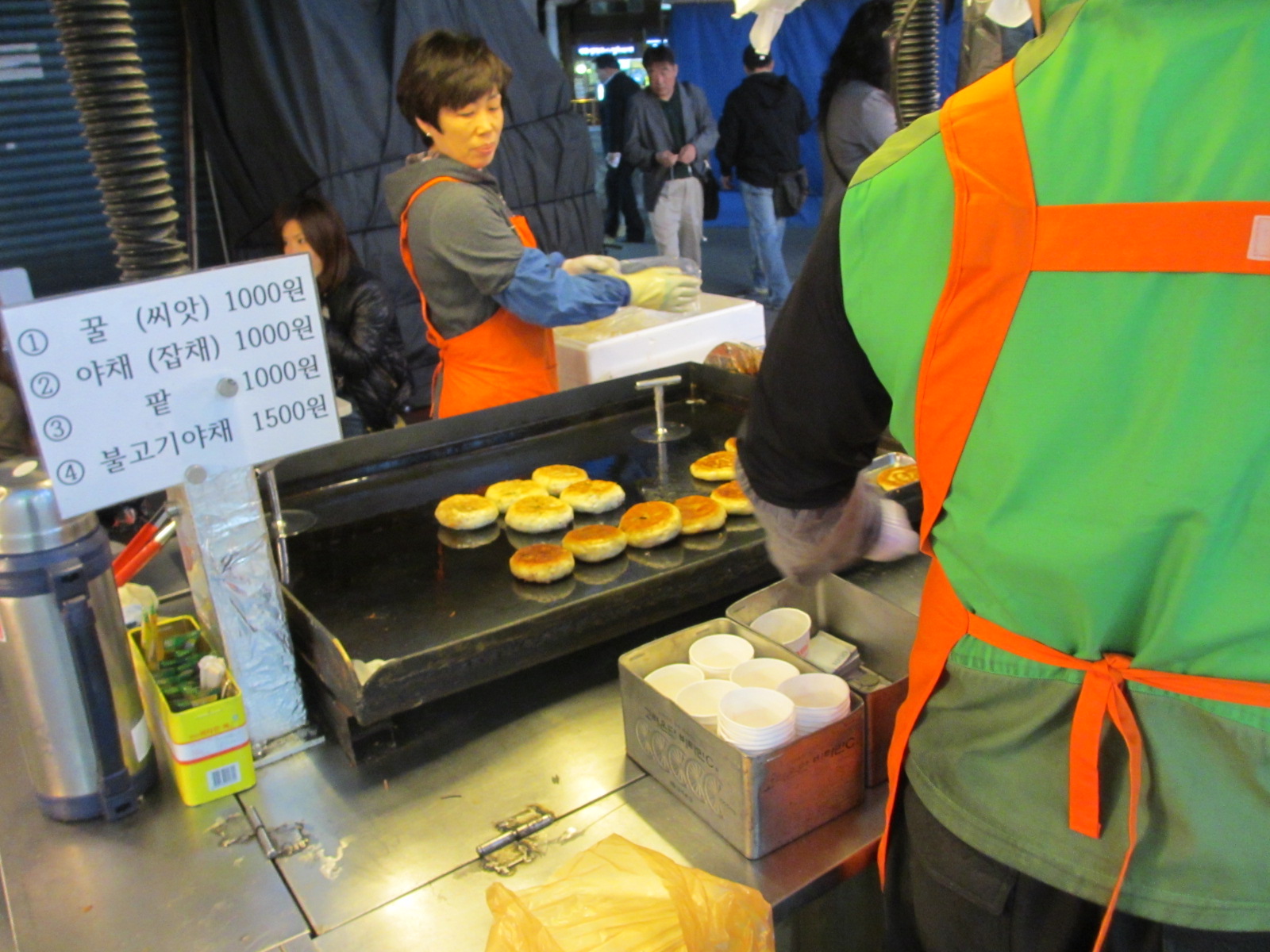
Why did we go back to the market? On Day 3, we'd had a delicious pancake thing -- it was stuffed with a sweet, sort of cinnamon-like filling and had black sesame seeds in the batter. They fry them up in little booths and serve them to you folded and stuffed into a paper cup, so hot that they're barely edible and you burn yourself because you can't wait to start eating it. I wanted to have it one more time before leaving the country, but we arrived at the market a little later than before and both of the places that we knew of had closed down for the night. We wandered around for a while and then eventually gave up and started heading back toward Myeongdong to get some real food to bring back to the hotel. Just as I was assuring Quinn that I wasn't all
that disappointed, I caught it out of the corner of my eye -- a booth that had stayed open later than the others. It was just as good as I'd hoped.
This was our "real food" -- spicy fried chicken with a really absurd (but wonderful) amount of garlic. The perfect thing to eat the night before a plane flight.
Day 5 wasn't quite so exciting; we basically spent the day getting back to Kobe. Gus, however, makes new friends everywhere we go -- this was in a shuttle bus at Kansai International Airport.
Enjoying the ferry ride from KIX back to Kobe.
Finally, Gus is back at home enjoying his souvenir. When we went out for meals we would always get a stainless steel cup (empty, of course) for him to play with and keep himself busy while we ate. He seemed to enjoy them so much that we got him one of his own.