Sunday, April 14, 2013

Kakegawa Shincha Marathon


In my last post, I alluded to a period of blog-silence. One thing that happened during that silent period is that I ran the Fukuchiyama Marathon again, in late November of 2012. The reason I didn’t blog about it at the time (other than me being lazy) is that I was a little embarrassed. I got a decent time (about 3:11, I think), but the race was a disaster. Quinn didn’t really get the distinction; her logic was that if my time is an improvement over the previous one, then the race was a success. The problem is that it didn’t feel like a success – I’d been hoping to break 3 hours and was on track to do so (by a pretty wide margin) until about 32 kilometers (20 miles) in; at which point things fell apart. In distance-running lingo, I bonked. I had no energy left and the thought of running another step was unbearable; I stopped and walked for a while, then sort of alternated walking and running for the last few miles. My legs didn’t even really hurt all that much; the entire problem was that I just ran out of energy.

There are a few possible reasons for this; Gus was about 3 1/2 months old at the time, and none of us were sleeping much or able to focus on much of anything. That’s a lame excuse, though. The real reason is that I did the whole thing without much of a plan. My training plan basically consisted of running a whole lot of miles at whatever pace felt good, my race plan consisted of starting with my 3:00:00 goal time, dividing by 42.195 km to get 4:16 per km, and figuring that if I tried to run every km under that time then I’d be fine. Not so much. I was frustrated with myself, and by the next morning I was itching for a do-over.

So I signed up for the next race I could feasibly train for, the Kakegawa Shincha Marathon (掛川新茶マラソン) in Kakegawa, Shizuoka prefecture. The name means “Kakegawa new tea marathon” – they grow a lot of tea in the area, and at this time of year the new leaves are just coming out. I was determined to do everything differently this time; I got myself a very focused training plan from Marathon Nation that had me running harder and faster than ever before, I wrote out obsessively-detailed pre- and post-race plans, and I was determined that this time I would hit my goal of a sub-3:00 marathon.

Here’s the timeline, in pictures:

The evening before the race, I caught the Shinkansen to Kakegawa, checked into my hotel and headed out for dinner. I was looking for something carbohydrate-rich, predictable, and familiar, and I wound up at Coco Ichibanya. For those who aren’t familiar with it ここいち (as it’s affectionately called) is a chain restaurant that serves Japanese brown curry. It’s decent, and I eat there often enough to make it predictable and familiar. I asked for extra rice (400g total) and made a point of not asking for extra-spicy (which I usually do).


Then I went back to the hotel, pored over the race map and elevation chart some more and was in bed by 9:30pm.

At 5:30am (4h before race start), I woke up and went for my pre-race breakfast. The advice I found on this recommended a carbohydrate-heavy meal (about 1.2-1.5 g per pound of body weight); I was looking at English-language sites so they were very enamored with bagels and oatmeal. Those are sort of exotic here so I went Japanese-style, with daigakuimo (honey-glazed sweet potato) and onigiri (seaweed-wrapped rice balls). I’d done this exact breakfast 4 hours before one of my training runs, but I had a lot more butterflies in my stomach this time.


At 7:30am (2h before race start), I went down to the hotel breakfast area for the second carbohydrate-rich breakfast installment: bread and orange juice. To the left is the race course map, which I’d pretty much memorized by this point.


By 8:30am (1h before race start), I was at the train station waiting in line for the shuttle bus to the race start. Waiting in lines is a time-honored Japanese distance running tradition. If I had to do it all over again, I would have gotten on the bus a little earlier; I was a little bit rushed trying to figure out where the starting line was, stash my backpack, etc.


This is a view out the bus window at some of those famous tea fields. I really had no idea that this is what tea plants look like.


This is my pace plan, copied to the back of my left hand. The ink held up fairly well while I was running, but my reading skills didn’t – next time I’ll write the last few bigger than the rest.


At 9:00am (30 minutes before start), I had the last installment of pre-race breakfast, a “One Second” energy gel. These things are proof that they don’t actually make everything smaller in Japan – 41.4g of carbohydrates in one squeeze. It usually takes me longer than one second to get the screw-top open, but from there the delivery is as quick as advertised. They’re a little too big to fit comfortably in the pockets of my running shorts, but I’d brought four of them to stick in my pockets, planning to put one down every 40 minutes or so.


The race staging area was in a big field in Tsumagoi (つま恋, literally “wife love”) park. The weather was nice (warmish but mostly cloudy), and people had tents and tarps set up. There were booths with food, souvenirs, etc. around the perimeter and a stage set up with live music. I left my stuff in an easy-to-find spot and headed for the starting area.


Once I got into the starting corral (packed in like sushi, as they say), I suddenly realized (to my horror) that I’d forgotten the gels that I’d planned on putting in my pockets. They were still sitting in my backpack, and there was no way that I’d have time to run over, grab them, and make it back before the start. I just reminded myself that part of the plan was to stick with the plan even if some pieces of it don’t work out, and promised myself not to pass up on any drink stations.

My goal was to finish in 2:59:55, leaving myself a small margin of error. That translates to a 6:52/mile pace; my plan was to run 7:07 miles for the first five miles, and speed up to 6:47 for the next 15, then have the option of slowing down to 6:52 for the final 6.2. I usually spend the first few miles of a race weaving through the crowd, jumping up on sidewalks to pass people and generally getting the adrenaline pumping. This time, I made an effort to keep it slow and conservative and let lots of people pass me.

I stayed on my pace (actually a tiny bit ahead of it) until the 5 mile mark, and then started to speed up as the initial hills ended and the race flattened out. I actually had a little bit of trouble setting my “cruise control” to 6:47 after running a few miles at 7:07 – I can run fast and I can run slowly, but staying at an in-between pace like that is challenging sometimes. After about two miles I’d gotten into the rhythm of a 6:47 pace and managed to stay there from then on. I lost a little bit of time during those first couple of miles, though – it didn’t help much that I had a headwind for most of the first half of the race. In keeping with my plan, though, I forbade myself any thinking (in particular re-adjusting the plan) until I got to the 20-mile mark and had some sense of what I had left.

After 20 miles, I was about 30 seconds behind my planned-out split time, but still felt really good. I decided that instead of slowing down, I would run the last 6 miles at about a 6:47 pace, so that I could make up those 30 seconds. The last 6 miles were fairly hilly, so what I really ended up doing was running about 6:30 on the downhill parts and then just trying to keep moving on the uphill parts. The last mile was all uphill, and I took it as fast as I could. That last mile was without a doubt the most difficult thing I’ve ever done while running; I just kept repeating to myself “I’m going to make it, I’m going to make it.”

And make it I did – 2:58:41, more than a minute faster than my original goal. I was a little worried that I might faint (the people running the finish area were probably even more worried), but I managed to hold it together.

When I got back to where I’d left my backpack (and those four energy gels), I got my camera out and asked someone to take my picture. It’s not a great picture of me, but it captures the moment perfectly. My eyes are closed, but not because I blinked. As soon as I handed off the camera, my right calf seized up and I’d closed my eyes because it hurt so much. But I’m still smiling.


I left Quinn a voice mail to let her know I’d survived, and drank a whey protein shake thing that I’d packed as a post-race toast. The next item on my post-race plan was to head to Shinrin no yu (森林乃湯, literally “hot water in the forest”), a hot spring bath located at the north end of the Tsumagoi. There was supposed to be a shuttle bus, but when I got to the area where it was supposed to pick people up there was no bus and no one waiting for the bus, so I walked, eating most of a loaf of raisin-walnut bread while walking (also part of the plan).

I don’t have any pictures from Shinrin no yu because, well, it involved a bunch of naked dudes and they frown on picture-taking. (I didn’t actually ask; I’m just assuming.) Totally the best post-race activity ever. In addition to the usual hot-water baths, they also had a few cold-water baths that were probably getting a lot more traffic than usual, as people were using them to ice their battered muscles in between (longer) stays in the hot baths. My legs felt much better after several rounds of the hot-and-cold treatment.

Then it was a shuttle bus, another shuttle bus, a panicked search for an ATM, and a Shinkansen ride home. I'm definitely not in the mood for a do-over this time. In fact, after I finished I saw some kids (presumably waiting for a parent to finish the race) doing something that might become my new preferred form of exercise for the near future.

 Bungee-assisted trampoline! How cool is that?

Saturday, April 13, 2013

Hanami with giraffes


OK… so it’s been a long time since our last blog post. A really long time. What happened is that we really didn’t want to turn this into one of those “baby blogs”, where new parents share cute pictures and developmental milestones with the whole world. What we hadn’t counted on is that the last 8 months or so have been sort of thin on the non-baby-centric activities, so we ended up not posting anything. Instead of a baby blog, this turned into a culminates-with-baby blog.

Now, though, spring is here and we’re ready to emerge from hibernation and take our offspring out to see the world. A couple of weeks ago, for example, we went out for hanami (花見, cherry blossom viewing) with some people from RIKEN. Last year’s hanami involved a lot of sitting in one place eating and chatting; this year was a little more action-packed.

The first destination was the gokukjinja (護国神社, a shrine honoring the war dead) in Kobe’s Nada Ward. Apparently Japan’s fallen heroes like cherry blossoms a lot. We had a picnic lunch with o-bento to fortify ourselves for the arduous flower-viewing that lay ahead.


From there, we walked over to the “Sakura Tunnel”, which is a narrow road up a rather steep hill that is planted with cherry trees on both sides, so that when they bloom it forms a cherry blossom tunnel.


The final destination was Oji Zoo, which has an impressive collection of cherry trees. It’s also a zoo that lets elementary-school age kids in for free, so on the first really nice Saturday of the spring it was packed.


This giraffe was appreciating the cherry blossoms in a different sort of way.

For next year, I think the gokokujinja is definitely worth hitting again, but we’ll probably skip the zoo. In general, a pretty good hanami experience.

Sunday, August 19, 2012

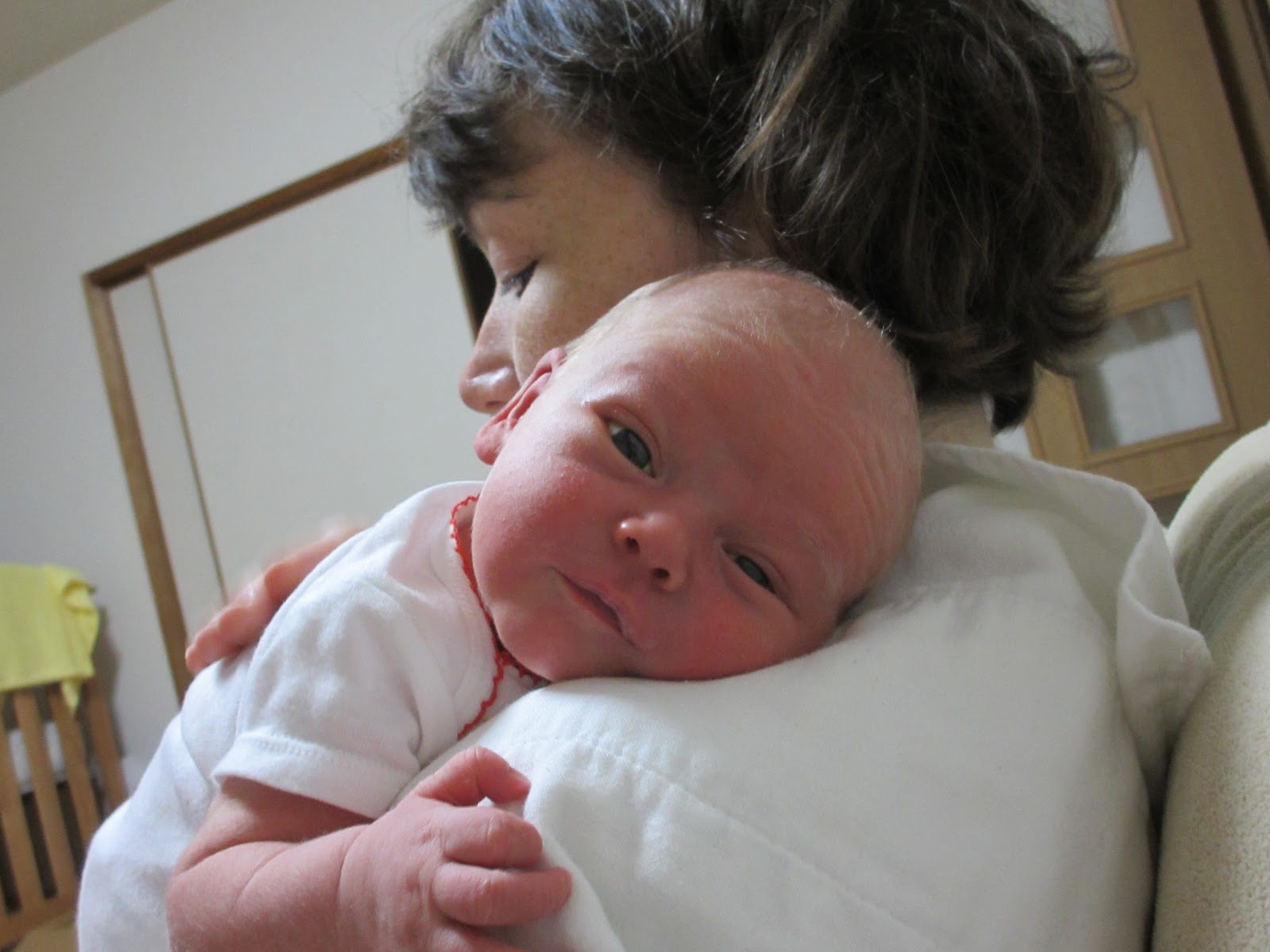
Introducing. . .

August Charles Spadola Jolley
He was born on August 9th at 10:23am.  He weighed 8 lbs 5 oz and was 19.7 in long.


Saturday, July 14, 2012

8th Wedding Anniversary


 Craig took Friday off and we went to Kyoto to celebrate our 8th wedding anniversary. We'd heard a new aquarium had opened and was boasting about being the best in Japan. For those of you with some sense of Japanese geography, this may be surprising because Kyoto is inland and no where near the ocean. We learned, however, that it sits in a large river basin and the aquarium tried to take advantage of that unique water environment. Between the two of us, we've been to 4 different aquariums in Japan. Unfortunately, I would rank Kyoto at the bottom. Craig puts Churaumi in Okinawa at the top. I haven't been there so I put Osaka at the top followed by Suma and, lastly, Kyoto.

 We took our time getting into Kyoto, had lunch and then headed to the aquarium. We were worried because it was looking like we'd only have three hours to see the place. We finished in plenty of time.

Kyoto had your standard big tank with lots of fishes swimming about, a jelly fish exhibit, some small tanks with little fish, a very, very short dolphin show, penguins, seals, and some river life. Most notably, they had giant salamanders, Chinese, Japanese, and a hybrid. These guys were literally the size of a cat but were mud colored salamanders. We never saw them move, they'd contort themselves so they'd be under rocks, sand, whatever they could get below, but stretch their necks up so their nostrils were just above the water.


One thing I do at aquariums is wonder what the animals on display would taste like. I am not alone because we heard “oishisou” “looks delicious” at a lot of tanks. At the last exhibit, what Craig figured would be the “guilt you with an environmental message” section, we saw something much more honest – instructions on cleaning fish and food models of our properly prepared fishy friends.


 The highlight of the trip turned out to be our celebratory dessert. When we were looking for a restaurant in the train station we passed a bakery with gorgeous tarts covered in fresh fruit. We decided we had to stop by on our way home. In the US I always felt like bakery stuff looked better than it tasted, but I can confirm that these were as tasty as they appeared to be.

Friday, July 13, 2012

The fishiest place in Tokyo


A couple of weeks ago (2012/06/29), I had the chance to travel up to the main RIKEN campus in Wako for one of their “Discovery Evening” events.  This was the second of the year; the idea is that they invite RIKEN’s young acronymed researchers (FPR, SPDR, IPA, and JRA) to the Wako campus (outside Tokyo in Saitama prefecture) where they hear a couple of informal-ish research presentations by their peers and then mingle and eat.  Most of the attendees are from Wako and Yokohama (also pretty close).  Gianluca Esposito, an FPR from Italy, is apparently heading up the committee that organizes these things and had e-mailed me asking if I wanted to come up to Wako and give a presentation.  So on Friday (06/29) I took the shinkansen up to Tokyo and did the discovery evening thing.

On Saturday I figured I’d traveled all the way up to Tokyo on someone else’s dime so I might as well do some sightseeing.  Because I managed to get to bed fairly early on Friday (the party ended promptly at 8pm), I decided to get up early and visit the famed Tsukiji fish market (築地市場駅).  All of the web sites I’d looked at said one should get there super-early, so I got up at 4:30 to catch the first subway out of Wako at 5:00, which got me to Tsukijishijo at about 6:00.  I stashed my luggage in a coin locker in the subway station, then stepped out and followed the smell of fish.


 Those are eels.  Apparently they bleed a lot.
Our invertebrate friends were also well represented.


I ended up in a big covered area with lots of people dashing about in narrow little aisles and lots of fish everywhere.  I was so engrossed in all the fishy amazingness that I didn’t notice that I was the only person around who didn’t seem to be… ummm…. working.  Eventually a nice police officer noticed that for me, and came over and explained that the “Seafood Intermediate Wholesalers Area” wasn’t open to the general public until 9:00.  So I had a few hours to kill.  He directed me toward what appeared to be the tourist area, where there were a lot of souvenir shops and (more importantly) sushi restaurants.  So I at least managed to start the day with a sushi breakfast.

 What the policeman hadn’t told me (and that I fortunately figured out on my own) is that right next to the official Tsukiji market there’s a great big unofficial market.  It doesn’t have the same frenzy of fresh-off-the-boat seafood activity, but there is a lot of pickled and dried stuff along with plenty of seafood that probably had been at Tsukiji earlier that morning.  Basically, if you want ingredients of any kind for Japanese food, that’s the place to be.  There were also lots of shops selling unusual cooking implements like fish-scaling tools.  There were plenty of free food samples to be had; I tried lots of different things.
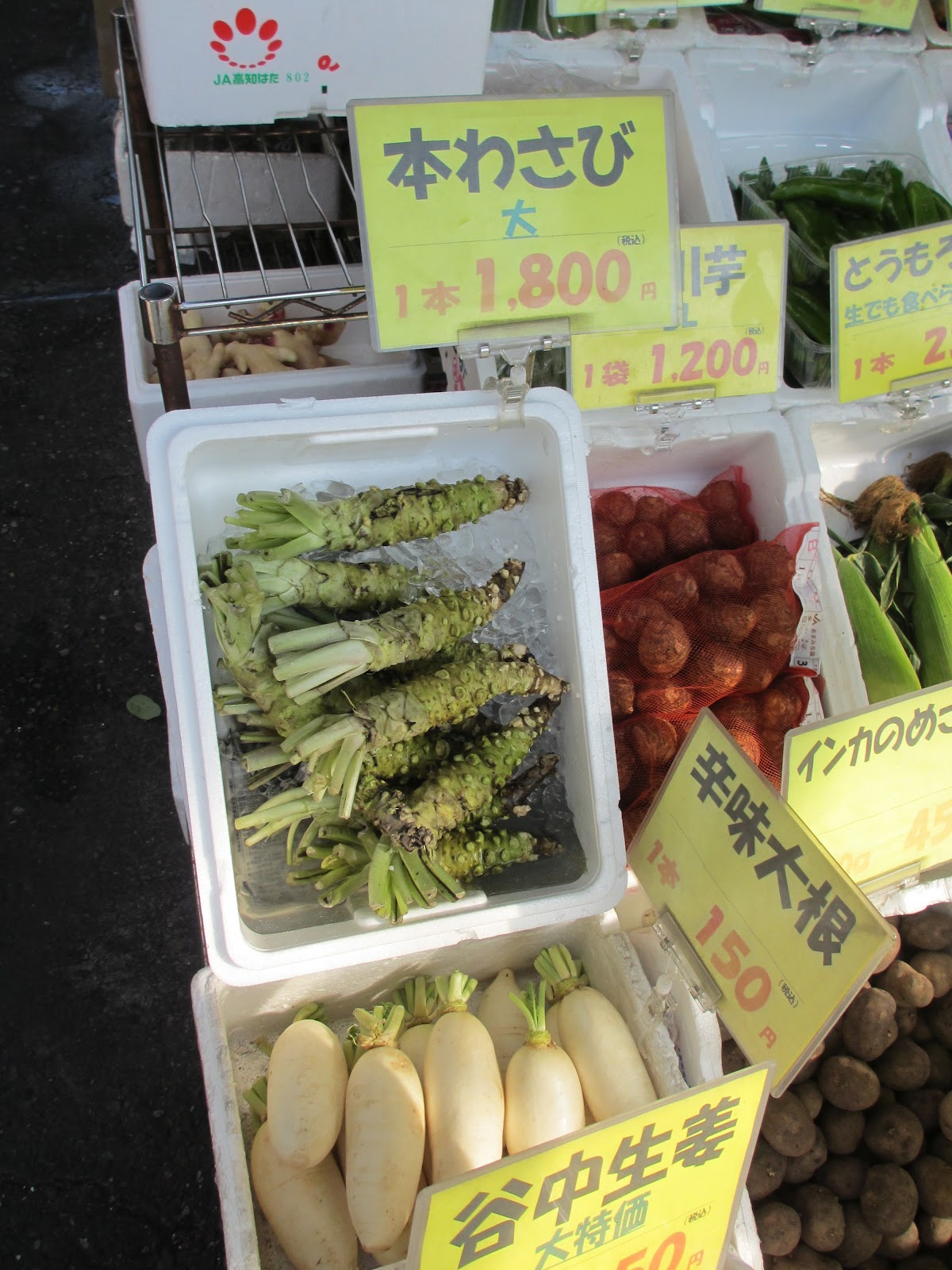
The funny-looking green things on the left (under the 本わさび sign) are fresh wasabi.  I had no idea that's what it looked like.
 There was a shop selling plastic models of sushi for restaurants to put in their display windows.
 Dried squid.

 This shop was fun; they had all sorts of different vegetables, all pickled.  Lots of samples.

 Those black things are sea urchins.
 Giant slabs of sashimi-grade tuna.
I brought this home for Quinn -- a trail mix with little dried fish in it.

When I made it back to Tsukijishijo after 9am, things had quieted down quite a bit, and most of the wholesalers where cleaning up; probably finishing a solid 8 hours of work.  It still seemed too early to go back to Kobe, and I wanted to check out another neighborhood of Tokyo.  Ginza was nearby and I’d heard of it, so I took the subway to Ginza.  I think if you like shopping Ginza is probably the most amazing place in the world; otherwise it’s not really so exciting.  Tsukiji is totally more my speed.

Wednesday, June 13, 2012

In Honor of Father's Day

I learned an interesting fact yesterday.  I was talking about golf with one of my English students and discovered "hole-in-one insurance."  I've never gotten a hole-in-one but I assume that in America, if you do get one, your buddies buy your drinks.  In Japan it is the exact opposite.  If you get a hole-in-one here you buy the drinks.  Seriously, you are expected to put on a party for your close friends and all the people with whom you play golf.  This isn't just a round of drinks at the club, either.  So people can buy hole-in-one insurance just in case they are "lucky" enough to get one and have to put on a party.

I talked to my dad on Father's Day and asked him what happened when he shot a hole-in-one.  Turns out he did have to buy the drinks (that's what happens when you assume) but it wasn't an all out party and just was the guys at the club house.

Sunday, June 10, 2012

Baby Shower - American Style

Yesterday two of my sisters from the Kansai Branch threw me a baby shower. Baby showers are not something people do in Japan so all of the Japanese women who came got to experience one for the first time. We had a brunch, which was delicious and featured actual breakfast sausage that Rachel had to specially order (I know, back to food but it was a real treat) and then played some games.

 Here we are flashing peace signs, there was some Japanese influence at the event.  Left to right, in the front row is Setsuko-san, me, Lisa, back row is Rachel (our host for the shower), Sister Zinke, Sakamoto-sensei, Ayumi-san, Sister Dalling, Sherilyn, Hazel, and Stephenie (who not only did a lot of the organizing but built the diaper "cake").
 One of the gifts was a baby yukata, sort of like a kimono but meant for warm weather.  Kim, the woman the gift was from, stated that every baby born in Japan needs to have one.
 I would have to say the most entertaining game involved everyone using toilet paper to guess how big around I am.
 Lisa made the best guess.
 Everyone else guessed a little big - I've still got two months but I don't think I'll grow another two feet in circumference.
I'm very grateful for all the friends I've made here.  It has and will definitely make it easier to have a baby so far away from family.  In Japan women usually have their moms present at the delivery, instead of husbands, and then go back home for a month so their moms can take care of them.  There are many things I've seen here that I think my mom would love, I know this is one of them.  She's got all her passport paperwork submitted and, even though she won't be here for the birth, I'm sure she'll make it here within the next two years now that she's got a grandbaby on the way.