Sunday, May 13, 2012

Golden Week Day 5: More Zhongshan and Causeway Bay


After spending the night on the couch at the Beccadome, I put on some mosquito repellent and set off for a guided tour of Zhongshan’s major tourist attraction, the Sun Yat-sen Park. 

I was a bit embarrassed at how little I knew about Sun Yat-sen – the guy helped start a revolution that overthrew the Qing dynasty, founded the (ill-fated) Republic of China, and is still considered a hero in both mainland China and Taiwan.  No wonder he got such a cool park.


We went to lunch at a noodle place where they pull the noodles by hand.  It looked really exhausting. 

After lunch, Becca took me to the ferry terminal to head back to Hong Kong.  While on the ferry, I had my first (and to date only) conversation entirely in Mandarin.  It basically went like this:

Me: Hi.  I’d like some water.
Very patient ferry employee: Eight yuan.
Me: Eight yuan.
Very patient ferry employee: Thank you.
Me: Thank you.
Very patient ferry employee: Don’t mention it.

It took me about 10 minutes to get up the nerve to do that.  I basically felt like a superhero afterwards.

After returning to Hong Kong I checked into my new hostel, YesInn@Causeway Bay.  Causeway Bay is a sort of shopping/entertainment district toward the east end of Hong Kong Island.  This hostel had a bit of a too-cool-for-school atmosphere about it; the hipster density was a little on the high side.  On the other hand, it was clean and the bathroom didn’t smell funny and it probably isn’t notorious as a hub for illegal activity, unlike some other places. 

While exploring around Causeway Bay, at one point I heard loud drums and gongs and things coming from around a corner.  When I went to investigate, I saw an art gallery (it seemed to specialize in mosaic art) with a bunch of very well-dressed people mingling about and some people doing a lion dance inside.  It was hard to get a good picture, in part because I really didn't feel well-dressed enough to try going inside.

The guys in the yellow pants were the ones doing the music.  And the woman with the wide-brimmed hat isn't an actual person; it's a sculpture covered in mosaic tiles.  As is the giant shoe bathtub.

I got some freshly-bottled sugarcane juice from a street vendor, which was awesome.  I also tried Hainan chicken, which had been highly-recommended by a friend from Hong Kong.  I wasn't crazy about the skin.

Golden Week Day 4: Po Lin to Zhongshan


On Day 4, I got up bright and early and had some Chungking Mansions Pakistani food, along with some durian.  This was my first experience with durian – it’s a fascinating little fruit.  Actually it's a pretty big fruit.  When I opened up the package I’d gotten from the supermarket, the first thing I noticed was the smell: strong and not entirely pleasant.  Then I took a bite, and thought it tasted horrible.  Since I’d paid for it and didn’t want to throw anything that smelled that badly in a shared garbage can, I continued eating it.  After a couple of minutes, I started to like it.  A couple of hours after finishing it, I started wondering where I could get more.  I’ve heard that starting smoking is sort of like that…

After breakfast, I packed up my backpack, checked out of the hostel, and caught the subway out to Lantau Island to visit the Po Lin Monastery, home of the Tian Tan Buddha, also known as the Big Buddha.  From the Tung Ch ung station I took a bus that seemed to just keep climbing through heavily-forested mountains.  All of the green was pretty amazing after a couple of days of concrete jungle.  When we arrived at the monastery, it was very cloudy and misty.  All of the pictures I’d ever seen of Po Lin were taken on clear, sunny days; I’m actually not sure which is more typical.  While the mist made the sculpture difficult to appreciate from a distance, it helped to create more of an ethereal atmosphere than a sunny day would have.

 There were a couple of stairs.
 At this point you could finally see him.

 The Big Buddha statue is flanked by an entourage of Bodhisattvas.  Each one is holding something different.

 
Underneath the Tian Tan Buddha there’s a nice little mini-museum that has paintings with a timeline of the life of Siddhartha Gautama (a.k.a. Buddha).  There’s also a real Buddha relic that was apparently given to them by whatever organization is in charge of keeping track of such things.  Understandably, they didn’t want that photographed.  It was in some case thing that was so complicated that you couldn’t really get a look at it anyway.

 You can kind of see him through the clouds there.

After seeing the Big Buddha, I looked around at the actual monastery a little bit.  Although there were lots of tourists around, I liked that it had the atmosphere of a functioning monastery – it’s not something that exists for the sake of the tourists.  A big part of it was actually under construction.  There were also signs all over (which I lacked the foresight to photograph) reminding visitors that alcohol and meat were not to be consumed on the premises.


 You can sort of see the new building under construction (it's sort of grayish) in the background.

 There were a bunch of these things around -- that statue style is also very common in Japan, and it depicts a story where, immediately after being born, Siddhartha jumped up and started talking.  And was pretty ripped, if you look closely.  People were taking those little ladle things (near the pedestal) and using them to pour water over his head; I'm not sure what the significance of that was.

You can also get a vegetarian lunch at what appears to be the monastery cafeteria.  They also didn’t want you taking pictures there; I’m not sure why.

After lunch, I wanted to take the cable car back down to Tung Chung.  This required cutting though Ngong Ping Village, which is where all the tourist-trap stuff was.  My guess is that there was some kind of negotiated agreement where all of the kitsch (and meat and possibly alcohol for sale) was kept at a respectful distance from the actual monastery.  The one thing worth slowing down for in Ngong Ping was a pogo demonstration.  It was these three American guys who apparently tour around the world doing impressive stuff on pogo sticks.  It was way cooler than my pictures make it look.
 It finally cleared up a little as I was leaving.

The cable car ride down the mountain was an attraction all on its own.  You get really spectacular views of the mountains on the island, as well as the ocean and surrounding islands.  You also get an impressive view of the Hong Kong Airport, if you’re into that kind of thing.
 This would have been a better picture if I hadn't gotten so much of my own reflection in the window.

 The cable car mysteriously stopped for a minute or two while we were dangling over that water.
This poor kid just couldn't stay awake.  He and his dad (to the right) were visiting from Japan and seemed a little startled when I started talking to them in Japanese.

If I’d planned things out better, I could have caught a ferry directly to Zhongshan from Lantau Island.  Instead, I caught the MTR back to Kowloon, somehow located the China Ferry Terminal, and just barely made the ferry to Zhongshan, where I was going to visit my cousin Becca Rasmussen.  I was worried that I’d be up on the top deck of a ferry getting sunburned, but instead I was in an air-conditioned cabin with tinted windows where they brought us bottled water and snacks (I’d paid about $3.86 USD extra for the first-class seat).  They had a couple of TVs where they were showing what looked like a movie depicting the Long March.  I’d heard that there was a new Mao film in the works in China, but a few minutes of diligent googling didn’t produce anything (in English, at least).  The sound was turned off and there weren’t subtitles in any language, but it was certainly lit and staged in a way that made him look very saintly.  About what you’d expect, I suppose.

Becca and her roommate Rachel picked me up at the ferry terminal.  We rode around Zhongshan on a bunch of buses (they apparently don’t have a subway system yet), had dinner, visited the video store that hooks them up with bootlegged American rom-coms, etc.  In case her parents are reading this, her apartment is very nice and is in an extremely safe-looking neighborhood.  Honestly.  I didn’t do a very good job of taking pictures that evening, though.


Thursday, May 10, 2012

Golden Week Day 3: May Day in Central Hong Kong


Early on Day 3, two things became clear to me.  One is that I tend to be a morning person, and going on vacation doesn’t magically cure me of my early-rising tendencies.  The other is that Tsim Sha Tsui is a really busy neighborhood at midnight and a really quiet one at 7am.  Fortunately, some of the hole-in-the-wall Pakistani restaurants on the ground floor of Chungking Mansions are run by my fellow early birds.  Or maybe they stayed open all night; I don’t know.  Either way, dirt-cheap chana masala and paratha is a pretty awesome way to start the day.  That, and a stroll along Victoria Harbor, where I could look across to see the Hong Kong skyline.


 I took the subway across (actually under) the harbor to Central station, and set about exploring downtown (they actually call it Central).  This, I later found, was a somewhat ill-considered approach; Central is not designed to be explored on foot.  At least not on the ground.  If you insist on walking, Central is best explored from the raised walkways that run directly from one skyscraper to another, eliminating the need for things like sidewalks.  On the ground, Central is a frustrating tangle of pedestrian bridges and underpasses; it’s impossible to get anywhere.  While I was standing on a street corner looking at my map and trying to figure out where I was and how I got there, someone approached me wondering if I knew of anything worth doing in Central at 8am.  She was from Thailand and was on her way back to Bangkok after having lived in the US for several years.  Due to jet lag, she’d been up and wandering around Central looking for something to do for about 3 hours at that point and had run out of ideas.  She goes by Natasha – all of the Thai people I know have Western-sounding nicknames, apparently because the rest of us inevitably butcher their names.  She took this picture of me.


 We also went to Kowloon Park, where I got a picture of some flamingos.  It’s a pretty awesome park.


If you wander around back streets in Tsim Sha Tsui, you can also find halal butchers, particularly if you’re looking for something else.


Natasha went back to Central to meet a friend (who probably woke up at a more civilized time), and I had some noodles and soy milk for lunch.


After lunch, I went back to Hong Kong Island; instead of Central I checked out the Sheung Wan neighborhood.  They had lots of shops selling dried stuff – fish, herbs, and edible bird’s nests.  I’ve heard that they’re edible, at least – I’d have no idea how to prepare one.  I also saw a place selling dried ox gall bladders; apparently they’re important for Chinese medicine. 


Of course no trip to Sheung Wan is complete without riding the Mid-levels Escalator – it’s apparently the world’s longest.  Where else can you spend 45 minutes on an escalator? 


In the same neighborhood is the Man Mo temple.  It’s not all that big or impressive; the coolest thing about it is the incense spirals hanging from the ceiling.  In some places they put little plexiglass barriers under them to protect you from the falling ash; at Man Mo they just put up a sign warning you.  Keeping the appearance old-school, I suppose.


From Man Mo, I walked back through Central toward Hong Kong Park.  This time I’d figured out the elevated walkway trick and planned a much more intelligent route.  On the way, I got pictures of the signature skyscrapers from a few different angles.


Hong Kong Park has a big aviary full of tropical birds and photographers.  The photographers aren’t necessarily tropical.


They also have a couple of nice ponds and a waterfall; if you go behind the waterfall there’s a cool view of the Bank of China Tower with its notoriously malicious feng shui.


One thing that I’d missed on my early-morning pass through Central was the biggest picnic I’d ever seen.  According to my guide book this usually happens on Sundays, but since May 1st is a state holiday they apparently decided to do it again.  Hong Kong has a large population of Filipina migrant workers; a lot of them work as housekeepers.  On May Day the HSBC (Hong Kong Shanghai Banking Corporation) tower is closed for business, but two walls of the lobby open to the outside and they turn it into a big picnic space.  It was packed full of Filipinas between about 20 and 40; hardly any men or children to be seen.  They didn’t all fit there, so they also blocked off some of the adjacent streets and took up positions on the elevated pedestrian walkways.  If it had been a political protest it would have been really effective and intimidating, but I think it was mostly just a picnic.  Of course, when people whose job is to be helpful and unnoticed take over the financial district to have a picnic on their day off, there are certainly political overtones.


They also had a choir going.  They sounded much better than the one in Shanghai.


I caught the ferry back to Kowloon just after sunset and got some night views of the skyline.  Every night at 8pm they do a big light show that is designed to be viewed from the Kowloon side – several of the big skyscrapers have lasers going and flash their lights to a soundtrack.  The narration rotates between English, Mandarin, and Cantonese – I showed up on Mandarin night so I didn’t catch much of what was going on.


After the light show I went to the Temple Street Night Market in Tsim Sha Tsui.  I’m not much of a shopper, so the idea of haggling for junk doesn’t really appeal so much.  My favorite part was the Cantonese opera singers that had set up on one street.  Unfortunately, the palm readers had set up on the same street, so if you linger to listen to the music you’ll be accosted by people wanting to tell you your future.  I must have had my hands in my pockets so that the “not superstitious” crease wasn’t visible.  I ate some kind of meat on a skewer that I forgot to photograph and that made me feel vaguely unwell. 

All in all, a pretty awesome day.

Tuesday, May 8, 2012

Golden Week Day 2: Pudong to Chungking


On Monday morning I woke up bright and early and started getting ready to journey onward to Hong Kong.  Interestingly, neither this hotel nor the one I stayed in on the way back gave me an alarm clock.  I don't know if they're worried about the clocks getting stolen, or if there's some cultural thing about alarm clocks.  I know they make lousy gifts in China.   

Anyway, I figured I would play it safe and do the hotel breakfast buffet.  I wasn’t expecting much, because the hotel had a generally sort of run-down look to it (as did the entire neighborhood it was in), but I was pleasantly surprised.  Of course there were no traditional Western breakfast foods to be seen (nor was there miso soup), but I cleaned up on sautéed greens and steamed buns and rice porridge, which made for a pretty solid breakfast.  I got back on the subway and back on the Maglev and back to Pudong airport.


Once I got through security and made it to my gate, things took a turn for the worse.  First we were told that our flight was going to be delayed.  They wouldn’t estimate for how long, but put up a sign in Chinese, Japanese, and English explaining that the flight was delayed and we should wait around in the boarding area for more details.  The Japanese text just said that the flight was delayed due to weather, the English version specified that the problem was yesterday’s weather.  It was not lost on anyone I talked to how little sense that made – apparently the real problem was that weather issues elsewhere in China had led to our plane being delayed somewhere else so that it took them a long time to get it to Shanghai and pick us up.  At least that’s what the other passengers speculated.

If they’re not good at providing information, one thing that Chinese airlines do take seriously is feeding their passengers.  Last week I took a total of four flights on China Eastern Airlines, each of them about 2 1/2 hours, and got a meal every time.  They really don’t want to pass up an opportunity to give you food.  So once it became clear that we were seriously delayed they started handing out boxed lunches.  Which was a good thing, because the inside-security food options in Pudong are pretty sparse. 

Once we’d been delayed about four or five hours, things started to get interesting.  A couple of flights that were supposed to be after hours had left from our gate.  Another flight to Hong Kong was moved to our gate, and then inexplicably canceled – we were still merely delayed.  In Japan, I suspect that people would just stay in their seats and show their outrage by (maybe) exhaling audibly in frustration.  That’s what all the Japanese tourists I met seemed to be doing.  The Chinese passengers decided to be more proactive; they basically formed an angry mob around the gate desk and there were a bunch of people shouting at the gate staff.  Of course everyone knew it wasn’t their fault, but being a scapegoat is part of the job.  Once the angry mob had formed, they were surrounded by a bunch of people with video cameras and cell phones documenting the whole exchange.  Then the police came down and started trying to protect the gate staff from physical harm.  I can only assume that they were politely asking people to please calm down, with predictably limited success.  As for me, I just figured that I was on vacation and wasn’t going to get stressed out no matter what.  Deciding that in advance made the whole experience reasonably pleasant, given what I had to work with.  

The real silver lining behind getting stuck in the airport was having a chance to meet more of the other passengers that one otherwise does.  If everything goes according to schedule on a 2 1/2 hour flight, I often don’t talk to anybody.  As it was, I met a group of Japanese tourists from Hiroshima, an American guy who chairs the vocal department at a music school in Hong Kong, a couple from Hong Kong who’d been living in Vancouver for years and were moving back, a woman from Guangzhou who’d been in Osaka on business, a whole family that looked very Chinese and spoke very British and could have been from anywhere, a family from Australia who had been visiting their daughter in Shanghai… people who knew Hong Kong very well gave me tips on places to visit and things to try doing while I was there.  Being in an unpleasant situation just makes people friendlier, sometimes.  As long as you’re not the scapegoat at the gate desk.

Eventually, after a little over 7 hours, we did take off.  Just before we boarded, they gave each of us 400 RMB (about $63 USD) to compensate us for our trouble.  Once we were in the air, of course, they fed us again.

The Hong Kong airport was roughly what you’d expect.  Clean, orderly, full of high-end places to shop.  The subways had announcements in Cantonese, Mandarin, and British-accented English, along with little signs warning you to mind the gap and make sure to hold on to the handrail on the escalators. 

A couple of weeks before leaving, I’d been looking through a Hong Kong guidebook that I’d bought for information on places to stay, and thought I’d try spending a couple of nights in Chungking Mansions.  Apparently it’s legendary in Hong Kong (at least according to Wikipedia); one of those places that you just have to see.  Of the many, many guest houses there (16 stories worth), the guide book recommended Chungking House as being the most comfortable.  I looked on their website and there was no way to make reservations online; just an e-mail address to contact for reservations.  So I e-mailed them and said when I’d be coming and leaving and that I’d need a single room.  I got an automated reply saying they’d get back to me ASAP, then nothing.  After a week I tried again, with the same result.

So when I finally arrived at Tsim Sha Tsui, the neon-covered epicenter of downtown Kowloon, and found the Chungking Mansions building.  When you walk in the door there are two elevators, one of which only stops at the even-numbered floors and the other of which only stops at the odd-numbered floors.  There’s an attendant standing by the elevator ready to drag you out of the elevator if you send it over its weight limit, which happens whenever more than four or five people try to get on.  So I had to wait in line for a few rotations before even getting on the elevator.  When I got to Chungking House on the fifth floor, I encountered a Chinese guy behind the front desk who was smoking a cigarette and glaring at me with intense disapproval. 

Me: Hi, I think I have a reservation…
Desk guy: That’s impossible.
Me: Ummm… well…. I sent an e-mail to the address on your website…
Desk guy: Nobody checks those.
Me: So do you have any rooms?
Desk guy: No.  Actually there’s one with a twin bed, but it will be more than you’ll want to pay for it.
Me: Oh.  Can you recommend anywhere else?
Desk guy: No.


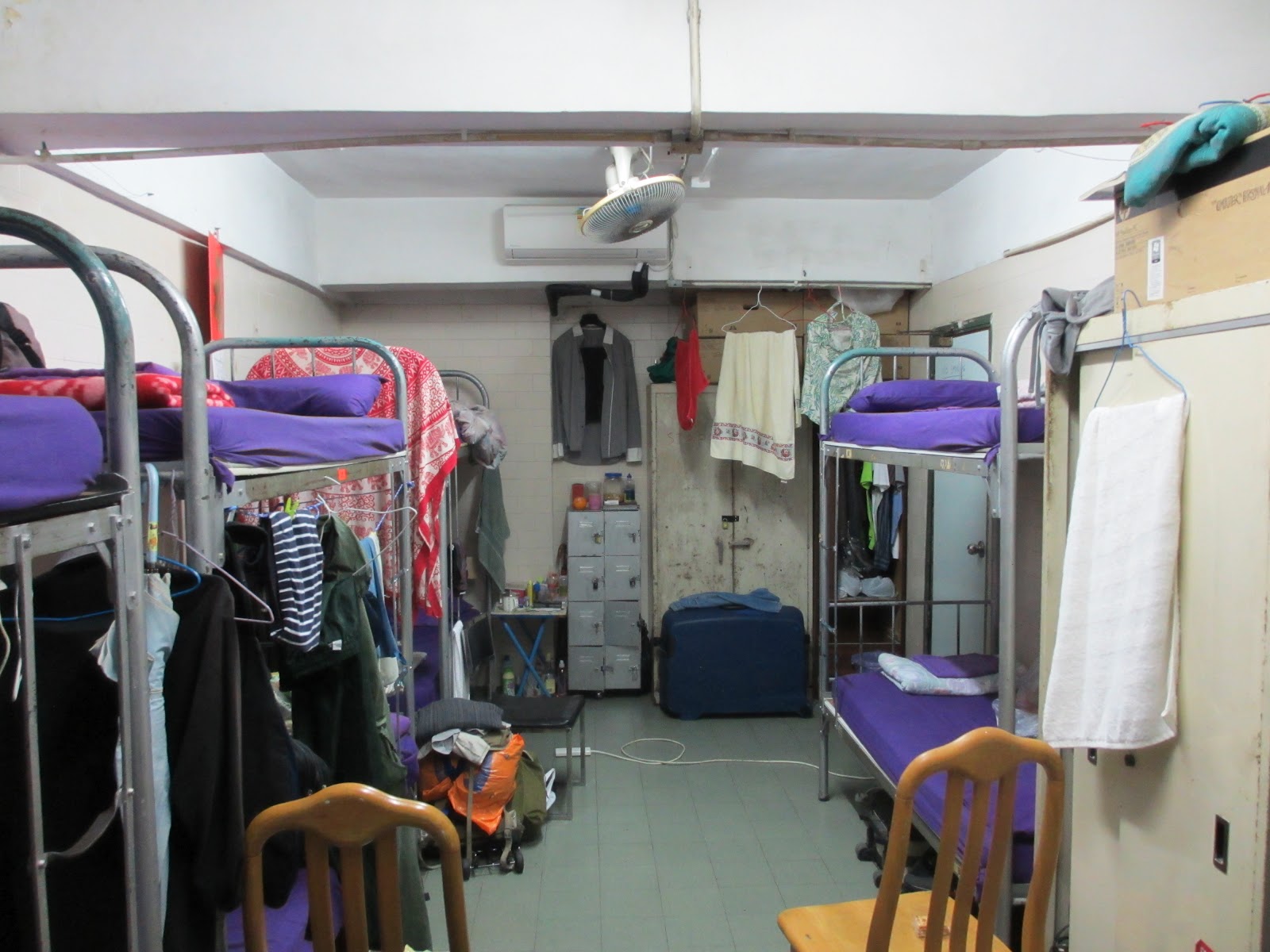
So I got back on the elevator going down, and then got back in line to go back up the elevator.  My new plan was to go up to the top floor (16) and just work my way down until I found a place to stay.  On the 16th floor I found the auspiciously-named “Traveler’s Hostel”, run by another mean-looking Chinese guy who (for reasons I never understood) everyone referred to as “Papa.”  He offered me a bunk bed in a room with 9 other people for $65 HKD (about $8.37 USD).  It looked like the kind of place you could stay for $8.  Actually it was pretty much the sketchiest place I’d ever spent the night (sorry Ajo, AZ, you’ve been replaced). 


Chungking Mansions, however, is absolutely fascinating.  It’s a big bubbling melting pot – while I was in line for the elevator I saw Arab guys with skullcaps and long beards, Indian women in saris, lots of Indonesian women in hijabs, more Africans than I’ve seen total since moving to Asia, a smattering of European and North American backpackers, and probably some locals who were between apartments or waiting for a marital spat to blow over.  I ran into a Japanese college student who’d actually done an internship at CDB in Kobe.  One of the other people in my room was a fragile-looking Japanese girl who said she’d been living there for 9 months.  I guess if you have a job where you can only afford $250 worth of rent a month then you do what you can.  She’s probably a lot tougher than she looks.